The dispossessed status of exiled South Vietnamese veterans
The SympathizerThe dispossessed status of exiled South Vietnamese veterans describes more than the loss of a country or an army. In the United States, former officers and enlisted men are reduced to precarious work, social invisibility, and strained family lives, while their memories of service collide with the humiliations of exile. The General’s restaurant and his effort to form a volunteer army offer ways to recover a public identity, but the veterans’ longing for recognition is entangled with grief, resentment, and a military ideal of manhood that can make death seem preferable to life in displacement.
Material Decline and Family Strain
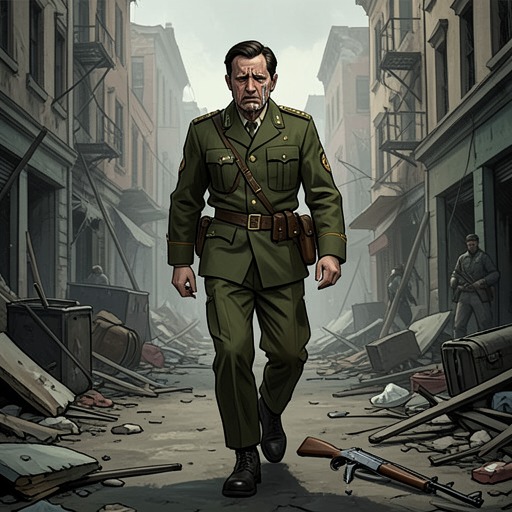
The veterans’ former ranks survive most visibly as contrast. Men who once commanded artillery batteries and infantry battalions now work as a pizza-parlor proprietor, a janitor, a mechanic, a short-order cook, or a deliveryman. Others collect welfare or remain unemployed in subsidized apartments. The unnamed narrator, who had known them as the General’s aide and reported on their lives to Paris, sees their pride persisting alongside the loss of the authority and resources that once defined their public roles. Their car keys, where they have cars, are among the few ordinary possessions left to men whose military power has vanished.
Exile also unsettles domestic life. The veterans interpret children’s growing command of English and their willingness to talk back as signs of estrangement, while some regard their wives’ employment and changed circumstances as a loss of the women they remember. Their nostalgia casts women and children as agents of Western contamination, even as the veterans themselves depend on families adapting to American life. The narrator suspects that memory has softened their recollections: these men had not spoken so fondly of their wives in Vietnam. Their present idealization of the past therefore sits beside resentment toward the people who have had to change in order to survive the present.
The crapulent major makes the pressure on male identity explicit by complaining that men in America no longer need to be men because women have their own independence. The narrator hears nostalgia in the claim, not an objective account of family life. The remark nevertheless captures how the veterans’ sense of dispossession reaches into the household: the loss of military command is accompanied by anxiety that familiar gender roles and authority have been lost as well.
A Restaurant Between Survival and Revolution
The General and Madame’s restaurant gives this dispossession a concrete, public setting. The establishment occupies a small, unrenovated former chop-suey house on Chinatown’s Broadway. Its battered linoleum, grease-speckled walls, dull yellow paint, and harsh lighting make it far removed from the dignified restaurant the General wishes he could own. He and Madame lease it rather than own it; Madame wears ordinary off-the-rack clothes, and the General has become a proprietor counting money at a cash register. The waiters are veterans in trucker caps and ill-fitting shirts, their former military identities difficult to recognize in the roles they now perform.
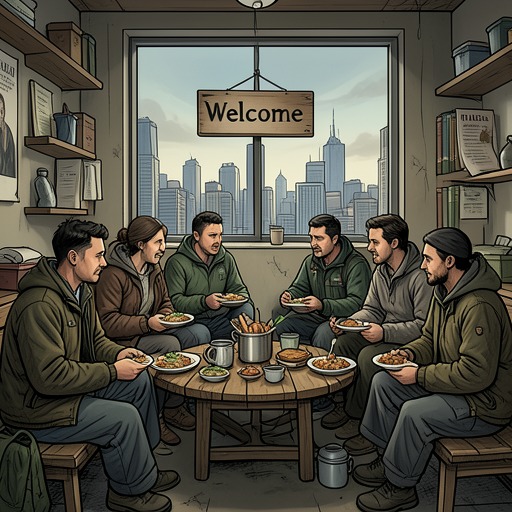
Yet the restaurant is also an act of persistence. Its customers fill the tables for Vietnamese soup, and the food, language, and shared meal create a taste of home in a setting where refugees must make unfamiliar food acceptable to American customers. The General calls the enterprise degrading, while the narrator sees courage in its attempt to build a livelihood and make Vietnamese food accessible. The scene holds both judgments at once: the restaurant sustains a community, but its modest surroundings remind its owners that their present social position is far below the status they once held.
The business also becomes a political resource. The General says that its profits go to the Movement, making the restaurant an open secret: customers can eat while understanding that they are helping the revolutionary cause. Madame organizes uniforms, a women’s auxiliary, and flags, and she has staged a Tet celebration in Orange County. The General describes volunteers training on weekends and announces a plan to send a reconnaissance team to Thailand to connect with a forward base and find an overland route toward Vietnam. The restaurant thus joins everyday economic survival to a projected return, though that return remains a military ambition rather than a completed recovery.
Uniform, Recognition, and Reassembled Purpose
At a weekend training exercise, roughly two hundred men sit on the ground before the General, who wears camouflage, a red beret, polished field boots, collar stars, and an Airborne patch. Madame has tailored the surplus uniform. For the General, these clothes reverse the appearance of the restaurant proprietor: they restore the bearing and public nobility he associates with his former life. The unnamed narrator, assigned to photograph rather than fight, also experiences his own uniform as a kind of armor, despite knowing that it could not stop a bullet or knife.
The men’s transformation is visible in their posture and movement. In civilian life they work as busboys, waiters, gardeners, field hands, fishermen, laborers, and custodians, or remain underemployed; as a group, they are easily overlooked. In uniform, field caps and berets conceal their ragged haircuts, their backs straighten, and they march rather than shuffle in worn shoes. The photographs record not only a drill but a temporary reversal of their social invisibility. The General addresses them as men and leaders, connecting their renewed presence to the people they hope to serve and to an imagined future in which they might return.
That appeal depends in part on personal recognition. The General remembers names and asks about wives, children, girlfriends, and hometowns; he walks among the men and eats with them. The narrator judges this attention as a force more sustaining than decorations alone. The volunteers’ desire is not simply to regain a country: they also want remembrance from the country they lost, their families, future descendants, and the men they used to be. The movement offers a collective answer to the degrading anonymity of exile, while the narrator’s photographs and coded reports carry its image beyond the training ground.
Grief, Masculinity, and the Risk of Return
The veterans do not all share the same reasons for joining or the same confidence in return. A grizzled captain says his family was separated from him during the evacuation from Da Nang and that he has heard they were sent to clear swampland because of their relationship to him. He imagines going to retrieve them. An affectless lieutenant says his family is dead. The captain, who has ordered men to their deaths, says he is ready for his turn and regards war as preferable to the life he has in exile. These losses make the prospect of a dangerous return legible as purpose, not merely as strategy.
The narrator argues that the men should not be dismissed as fools. He compares their organizing to earlier revolutionary formations that began with primitive weapons and later became a large army. In his account, the General’s care for individual histories helps the veterans imagine themselves as more than a defeated mass. Their willingness to save for uniforms, boots, and guns expresses a hunger for recognition as well as a hope of recovering Vietnam. The narrator even contemplates returning with them, despite uncertainty about the General’s wishes.
Bon gives the same longing a harsher interpretation. He calls the veterans’ proposed mission suicidal and describes exile as a life without home or purpose. He connects their emasculation to the United States’ wartime promises and subsequent rescue, which he understands as having deprived them of agency and voice. His own definition of manhood centers on protecting a wife, children, country, and comrades; because he has lived to see those he loved die or suffer, he condemns himself as a failure. He says that former comrades who remained behind are dead or imprisoned, yet considers them more securely recognized as soldiers than the refugees in America. His account reveals how a military ideal can preserve dignity while also deepening shame and making self-destruction appear like the remaining proof of manhood.
Narrative Significance
The veterans’ condition is presented through an unstable contrast between civilian abasement and military revival. The uniforms make the men visible and straighten their bodies, but the transformation is temporary: it does not restore their families, former homes, or lost country. The General’s political rhetoric gives the volunteers a common purpose, while the narrator recognizes that the meaning of the people they claim to represent remains undefined. The movement’s power does not depend on resolving that uncertainty; it depends on the hope that the veterans can again belong to a collective.
The episode therefore refuses a simple choice between dismissing the exiles as defeated men and celebrating their planned return as heroic. Their restaurant is both a humble business and a source of revolutionary funds; their uniforms are both surplus clothing and symbols of restored status; their desire to fight can be aspiration, grief, or escape from a life experienced as imprisonment. Through the veterans’ changed work, family relations, bodily bearing, and competing accounts of manhood, the narrative shows dispossession as an ongoing struggle over who these men are permitted to be and whether recognition can be recovered without repeating the violence that helped destroy their lives.